Showing posts with label attracting birds to backyard. Show all posts

Tuesday, May 30, 2023

Yellow-rumped Warbler


Bird Watching In Southern Ontario

The Yellow-rumped Warbler

Warblers are one of the migratory birds found across Northern America that pass through southern Ontario, I had no idea they took a pit stop in my backyard during spring until I began birdwatching in my yard. Some like the Yellow-rumped warbler will even hang around the entire summer.  

The Yellow-rumped warbler is one of the larger warblers, it gets its name from the bright yellow patch at the base of the tail which makes it easy to distinguish from other warblers, especially the Magnolia warbler which is very similar in appearance, in fact when I was painting one I wasn't sure whether it was the Magnolia or Yellow-rumped warbler I was depicting.

Besides their yellow "butt" they also have some yellow on the sides below the wings and males have a visible yellow "cap" on the top of the head. And like the magnolia warbler, the Yellow-rumped warbler's white breast is streaked with black (Magnolia warblers have a yellow breast). As is the case with all warblers, it has a short pointed bill.

There are 2 subspecies of the Yellow-rumped warbler, the Myrtle warbler found in the north and east of North America, and the Audubon's warbler found in the west. The Myrtle warbler has a white streak above the eye whereas the Audubon does not not but has a yellow throat.

You won't find warblers at your bird feeder as they are not seed eaters, their diet consists of some berries, nector and insects found on the branches of trees. To attract warblers to your backyard you can plant berry producing plants. And since they like nector you might want to try putting out a hummingbird feeder in an attempt to attract warblers. Some have also been known to come to feeders containing suet.

If your backyard is visited by warblers, spotting one is difficult because they are very active birds that don't stay in one spot for more than a few seconds as they are always on the look out for a meal. Your best chance of getting a good look at one is during migration in the spring when there are more of them around and before leaves on trees have fully formed. If you are patient with a pair of binoculars you may just find a few flitting quickly from branch to branch, and one of them may be a Yellow-rumped warbler!

Did You Know?

The yellow-rumped warbler is the most common warbler in North America

The Yellow-rumped warbler winters in the souther US, Mexico and Caribbean

This warbler with the yellow rump is humorously but  affectionately is called "Butterbutt"


My Digital Bird Art of Yellow-rumped Warbler and Purple Iris Flowers

Available at Redbubble on an assortment of gift products and art prints

Monday, April 10, 2023

American Robin

 Birds In Ontario


The American Robin

What bird is more associated with spring than the American robin? In all parts of North America including here in southern Ontario, the American robin is a familiar sight in backyards at this time of the year and throughout the summer. But did you know that some American robins don't migrate to warmer areas, in stead they stick it out through the winter months? I myself have never seen an American robin in the winter, maybe it's because they spend the time high in tree tops since it would be pretty hard to pick a worm out from frozen ground. Or maybe the ones around here don't like the cold and head for warmer pastures. In any case the first sighting I get of them is near the end of March, when I see an American robin I know warmer weather is on the way.

This fairly large songbird belonging to the thrush family feels right at home in suburban as well as in rural settings. They are just as comfortable building their nest in trees as they are on house structures such as around downspouts and eaves as happened twice outside my kitchen window! I had a birds eye view (pardon the pun) of mama and papa taking care of the young.

American robins are often seen perched on fences with their head held high and alert. And who has not seen one on the ground scampering across lawns looking for earthworms. It's sense of hearing and eyesight allows the American robin to detect earthworms by tilting its head toward the ground. For years it was thought that it was listening carefully to the earthworm's moving under the soil but it is now thought that it also uses its eyesight, like many other birds, robins see independently from each eye and by tilting its head toward the ground it has a better view.

You are unlikely to see the American robin at the bird feeder because it is not a seed eater, their diet consists mainly of fruit such as berries in fall and winter, with earthworms and grubs making up a large part of their meals during the spring and summer.

What I like the most about the American robin is the well recognized sound of their beautiful melodies, hearing one outside my window in the evening on a warm summer day just fills the air with tranquility and makes me want to get out my brush and paint. The early morning and evening hours is when they are most vocal.


Did You Know?

One of North America's most familiar birds with one of the most recognizable melodies of all songbirds

The largest bird of the thrush family

It got its name from the European robin of which the early settlers to North America were reminded of.

Can have as many as 3 broods in a single breeding season. No wonder robin are so plentiful ans widespread!

Their eggs are a pale blue color and take 2 weeks to hatch


Personalized Keepsake Box


Personalized Robin Mug


Saturday, March 25, 2023

Attracting Black Capped Chickadees

Birds of Southern Ontario

The Black Capped Chickadee


An all time favorite for bird artists is the delightful Black Capped chickadee, they are often seen painted in winter scenes although they are year round residents in many parts of the US and Canada including right here in southern Ontario. The Black Capped chickadee is a frequent visitor to backyards and bird feeders and can be seen flitting from tree to tree and branch to branch as they do not stay in one place for very long.  

They are one of the most commonest birds in North America but on the rare chance that someone has never seen one, they have big heads, a black "beard", long tail for their small size, and a whitish belly with a tinge of orange on the sides. Their wings are grayish in appearance with white along the edges.

This small woodland bird likes to hang out in small groups with other chickadees as well as other bird species. It is and active little bird, somewhat of an acrobat, it can sometimes be seen perched upside down on a tree branch pecking away at a seed or looking for insects in the bark of a tree, making it a fun bird to watch.

It's flight is short and choppy and they are curious and not afraid of getting close people, so don't be surprised if one whizzes past your shoulder. They are also known for taking seeds from peoples' hands, though I myself haven't had that experience but I hope to one of these days.

Black Capped chickadees are one of the easiest birds to attract to your yard, all you need is a bird feeder filled with black oil sunflowers and they will be flying back and forth from tree to feeder for more seeds. Chickadees stay only long enough at the birdfeeder to grab a seed and fly off into a tree, there they hold the seed against the tree branch and break open the shell with their beak by pecking away at it as their head bobs up and down. As with a lot of other birds that visit gardens, a yard with evergreen trees provides shelter thus attracting not only chickadees but a host of other birds as well which can make for an interesting day of bird watching in the backyard.

Did You Know?

  • Chickadees get their name from the calls they produce although to me it just sounds like chattering.

  • Black Capped chickadees can be found as far north as Alaska. Talk about not minding the cold!

  • Chickadees stash their food for later and remember where they hid it, they hide in tree bark, under leaves and any other hiding place they can find.

  • Their nests are tree cavities or holes they find, they either make the hole themselves or look for one already there. They are also happy to use nestboxes.

  • Chickadees are very social birds except when it comes to breeding season at which time the males can become very territorial.

  • The most recognizable feature of the Black Capped chickadee besides their seeming social nature is the black beard or "bib" as it's called on their chin.


Stylized chickadee Art Poster

 
Buy a pillow


See more of by bird and other animal art at studioart.redbubble.com


Monday, February 27, 2023

Attracting Northern Cardinals


Northern Cardinal

 Winter Bird Watching In Southern Ontario


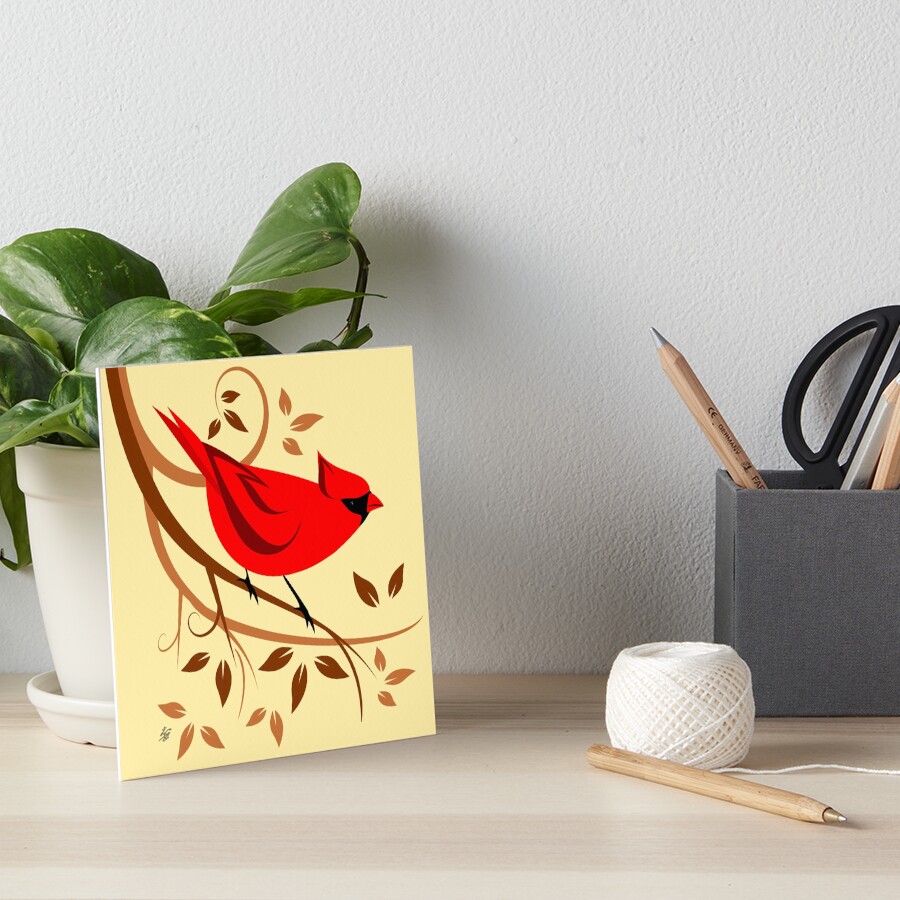
One of the most recognizable and favorite birds of North America is the Northern Cardinal, and we in southern Ontario are delighted that these beautiful birds make southern Ontario their home all year round. In fact southeastern Canada is as far north as these birds will go. The male with its distinctive crest on the head is a bright red color and the female is beige with tinges of red. These birds are a favorite subject for artists, and paintings often depict them in winter scenes. In fact winter is a perfect time to keep your eye out for them as the white of the winter snow makes cardinals easy to spot. During cold weather they can be seen perched on a tree branch with feathers fluffed up to retain heat, and that makes them look quite plump.

The easiest way to attract cardinals to your backyard is to fill the bird feeder with black oil sunflower seeds. Cardinals love sunflower seeds and will spend a great deal of time at the feeder munching away, and that will give you a good opportunity to observe them well. Another thing that will make cardinals feel right at home in your backyard is to plant evergreen trees, they provide shelter for birds, and if you can plant shrubs that provide berries such as the service berry and black berry shrub, all the better as it will provide both shelter and a food source. Seeds and fruit are the main source of diet for cardinals but they will also eat insects.

Cardinals are often found in pairs and sometimes in small groups. They are willing to share the bird feeder with other bird species, although at one time I did observe one pecking other birds away if they got too close to its share of the seeds. Male cardinals are quite territorial in breeding season and both male and female cardinals are sometimes seen fighting off their own  reflection in a window. During breeding season the male will bring the female seeds and feed her by beak, now that's a gentleman.

These medium sized birds measuring just under 9 inches, with the female being slightly smaller, are exquisite singers, their songs are a soothing melody to the ears on a warm summer day. While in many species of birds only the male sings, that is not true of the Northern cardinal, both the male and female make delightful melodies.


Did You Know?

The Northern cardinal is also known as the common cardinal and redbird or red bird.

They are only found in the new world inhabiting the eastern United States, southeastern Canada and can be found as far south as Guatemala and Belize.

Some cardinals are yellow because their bodies are unable to convert the carotenoids found in their diet which give their feathers the red color.

Northern cardinals do not migrate so you have an opportunity to observe and admire their beauty all year long.

They are members of the finch family.


 See my Northern cardinal art on products and prints at www.redbubble.com/shop/ap/33546653

and  www.redbubble.com/shop/ap/33677043https://www.redbubble.com/shop/ap/33546653?asc=u