Showing posts with label bird watching. Show all posts

Wednesday, April 10, 2024

Baltimore Oriole


Birds of Southern Ontario

Baltimore Oriole

 
Photo Credit: BBarrow/pixabay.com
 With a name like "Baltimore" Oriole you would think, or at least I thought that this handsome bird was first discovered in the city of Baltimore, but that's not so. The Baltimore Oriole was named after a prominent English Family of the 17th because their coat of arms consisted of similar colors. Now how's that for trivia!

Baltimore orioles are found through eastern and some central parts of the United States as well as here in southern Ontario. They arrive in spring and migrate during the fall season to their winter home in Central American countries and some parts of Mexico, even Florida.

In the world of birds, the male is more striking in appearance than the female and the Baltimore oriole is no exception with it's bright orange belly contrasted with its black wings, and black head that looks like he is wearing a hood. The female on the other hand is a dull orange yellow in color with brownish wings. Young males look similar to the females, it isn't until their second year that they get their distinctive coloring.


Baltimore Orioles are mostly solitary birds but often times when you see one there may be another one not that far behind.

I got my first good look at one when I put up a hummingbird feeder in the hopes of attracting hummingbirds. Well to my surprise instead of getting hummingbirds I got a Baltimore oriole coming for a sip. Turns out they love nectar and are known to frequent hummingbird feeders. They also love oranges so I got rid of the hummingbird feeder and put up half an orange. It didn't take long before one or two would be coming back for more.

Besides oranges they also like grape jelly though I haven't tried feeding it to them myself, for me it is easier to just cut an orange in half and place it where other critters can't get to it. No fuss, no muss and nothing to clean afterward. So if you want to attract Baltimore orioles to your backyard the easiest way and best time is with an orange in late spring because once summer is in full swing they prefer the delicacies of insects and will visit your "orange station" less often.

When I hear a Baltimore Oriole sing, to me it sounds sad, as if it is longing for something. I call it the sad song of the Baltimore Oriole and when I hear it I know there is one close by. Males sing to guard their territory and attract the attention of females, and the females sing to communicate. Click to hear the Baltimore Oriole's voice


Did you know...?

  • The name "oriole" comes from a Latin name meaning "golden"

  • The Baltimore Oriole belongs to the Icterid family of birds which also include Red-Winged Blackbirds and Grackles. But you gotta admit the Baltimore oriole is the prettiest of the bunch!

  • There's a baseball team named the Baltimore Orioles. Yeah I know, you knew that one.

  • New world orioles including the Baltimore Oriole, are unrelated to the orioles of the old world


    Baltimore Oriole Art 

    Buy A Print


Friday, June 30, 2023

Blue Jay Bird

 Birds In Southern Ontario

The Blue Jay 


The beautiful and well known blue jay is found in in the eastern parts of North America, especially around the Great Lakes region including right here in southern Ontario, and I must say it is one of the if not the most beautiful birds in Ontario. Its bright blue color, bold markings and large size makes it one of the most recognizable birds in the world and easy to spot if they are found in your area.

In some places Blue Jays stay all year round but they don't have a predictable migration pattern like other migrating birds, Blue Jays can leave after years of staying and head elsewhere for no apparent reason. I found this to be true, years ago Blue Jays were a common sight in my yard, a summer day didn't go by without me seeing or hearing one, then they suddenly disappeared. Years went by before I started seeing them again in my yard, not as often as I used to but for the past couple of years I see and hear one in my yard every now and then. So far this year I spotted a Blue Jay once in my neighbor's yard.

But not everyone is as enthusiastic as me about seeing them in the backyard, Blue Jays are aggressive and scare off other birds so they can have feeders to themselves. They also have been known for stealing eggs and baby birds from nests. Blue Jays are also loud and make a variety of sounds that don't even seem like it is coming from a bird. In fact I thought a sound I was regularly hearing when in my backyard was coming from a rusty old clothesline someone was using. I was totally blown away when I realized it was a blue jay making that sound. Yeah, they may be pretty but their loud noise is no music to the ears.

Blue Jays are also very good at imitating the sound of hawks, and use it to their advantage to scare birds away.

Blue Jays won't hesitate in raiding bird feeders so to keep everyone happy a large feeder can be put out for the Blue Jays and a small one for other birds. Blue jays love sunflower seeds and that is a sure way of attracting them. They also eat acorns and nuts, and will store them for the winter months when food sources become low. Their strong feet allow them to hold an acorn or nut while they peck through the shell with their thick beaks.

 DID YOU KNOW...

Blue Jays are slow flyers

They are very smart, in fact Blue Jays are so smart that they will shake a peanut to see which shell contains the largest peanut or will choose the largest nut by comparing its weight.

They belong to the crow family

They typically choose a mate for life

Both the male and female look the the same, unlike in many other bird species where male and female are quite different in appearance.

Four subspecies are recognized, the "interior Blue Jay", Northern Blue Jay"(this is the one found in Canada and the largest of the Blue Jays), Coastal Blue Jay" and "Florida Blue Jay" (the smallest of the Blue Jays)

 Blue Jay Art

Blue Jays are a favorite subject among bird and wildlife artists, here is some of my digital art of the Blue Jay, available as art prints on various gift products:

Stylized Blue Jay Art
Stylized Blue Jay


Monday, February 27, 2023

Attracting Northern Cardinals


Northern Cardinal

 Winter Bird Watching In Southern Ontario


One of the most recognizable and favorite birds of North America is the Northern Cardinal, and we in southern Ontario are delighted that these beautiful birds make southern Ontario their home all year round. In fact southeastern Canada is as far north as these birds will go. The male with its distinctive crest on the head is a bright red color and the female is beige with tinges of red. These birds are a favorite subject for artists, and paintings often depict them in winter scenes. In fact winter is a perfect time to keep your eye out for them as the white of the winter snow makes cardinals easy to spot. During cold weather they can be seen perched on a tree branch with feathers fluffed up to retain heat, and that makes them look quite plump.

The easiest way to attract cardinals to your backyard is to fill the bird feeder with black oil sunflower seeds. Cardinals love sunflower seeds and will spend a great deal of time at the feeder munching away, and that will give you a good opportunity to observe them well. Another thing that will make cardinals feel right at home in your backyard is to plant evergreen trees, they provide shelter for birds, and if you can plant shrubs that provide berries such as the service berry and black berry shrub, all the better as it will provide both shelter and a food source. Seeds and fruit are the main source of diet for cardinals but they will also eat insects.

Cardinals are often found in pairs and sometimes in small groups. They are willing to share the bird feeder with other bird species, although at one time I did observe one pecking other birds away if they got too close to its share of the seeds. Male cardinals are quite territorial in breeding season and both male and female cardinals are sometimes seen fighting off their own  reflection in a window. During breeding season the male will bring the female seeds and feed her by beak, now that's a gentleman.

These medium sized birds measuring just under 9 inches, with the female being slightly smaller, are exquisite singers, their songs are a soothing melody to the ears on a warm summer day. While in many species of birds only the male sings, that is not true of the Northern cardinal, both the male and female make delightful melodies.


Did You Know?

The Northern cardinal is also known as the common cardinal and redbird or red bird.

They are only found in the new world inhabiting the eastern United States, southeastern Canada and can be found as far south as Guatemala and Belize.

Some cardinals are yellow because their bodies are unable to convert the carotenoids found in their diet which give their feathers the red color.

Northern cardinals do not migrate so you have an opportunity to observe and admire their beauty all year long.

They are members of the finch family.


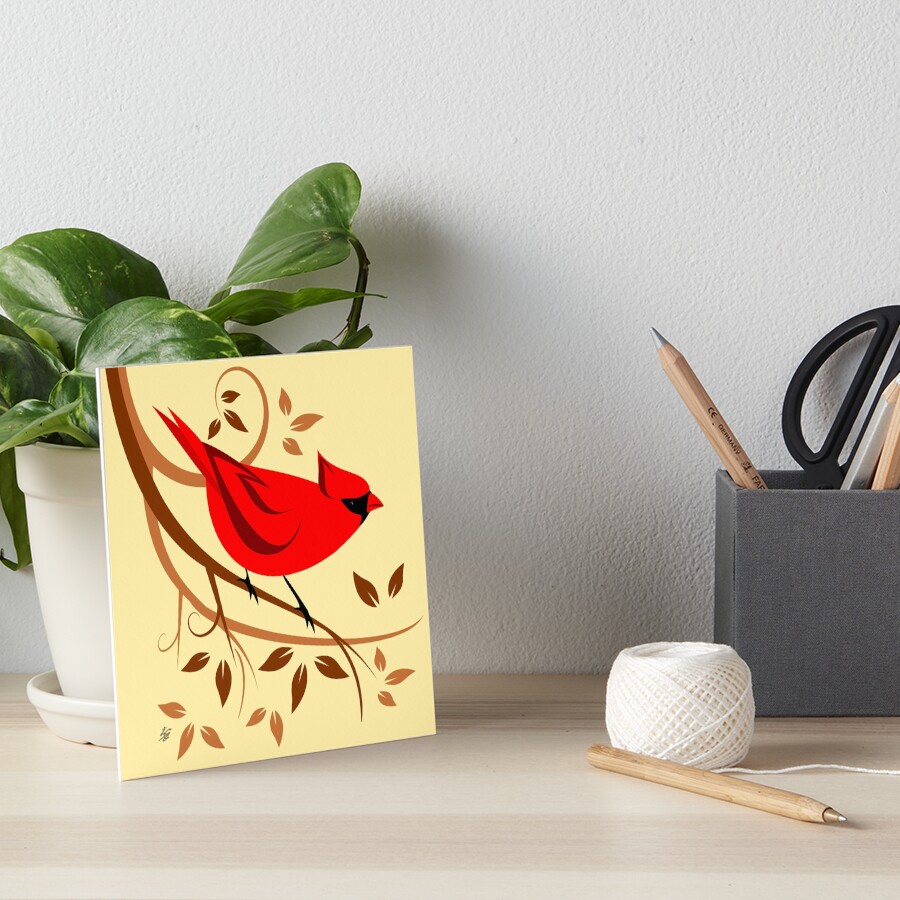
 See my Northern cardinal art on products and prints at www.redbubble.com/shop/ap/33546653

and  www.redbubble.com/shop/ap/33677043https://www.redbubble.com/shop/ap/33546653?asc=u

Monday, December 19, 2022

Junco Winter Bird Watching

 Winter Bird Watching In Southern Ontario


 If you live by the northern shores of Lake Ontario and you keep on the look out you may be surprised at the variety of bird species that call Southern Ontario their winter home. One of the most common winter birds that you are sure to see in your yard whether rural or suburban, is the Dark eyed Junco. It's arrival just in time for winter has earned it the nickname "snowbird".

 At first glance you may think it is a sparrow and you would be right, Juncos belong to the sparrow family, they are around the same size and have the same body shape you find in sparrows, but on closer inspection you will see that the Junco's appearance is quite distinctive from what you see in sparrows. The Dark eyed Junco has a pinkish beak, it's upper body, head and breast are gray with a white belly. And their white outer tail feathers make them unmistakable when in flight.

Juncos begin their arrival to southern Ontario in the fall and leave for cooler places up north at the approach of warmer weather during the spring for the start of breeding season. During the winter they are often found in flocks, so if you see one Junco chances are there are quite a few more close by. The place you are mostly likely to spot them is on the ground foraging for food. 

Juncos are known to visit bird feeders looking for any fallen seeds below. They enjoy a variety of seeds including the ever popular black oil sunflower seeds but they especially like millet seeds. When at their summer home way up north, a large portion of their diet consists of insects.

The Junco is a songbird, but it is only the folks living in areas juncos migrate to during the summer who get to hear their pretty songs, we here in southern Ontario have to be content watching them going about their business in the silence of winter. 

Did You Know? 

The word "junco" comes from a Spanish word meaning "reed" or "rush"( as in the plant) Juncos are found only in North America and have a lifespan of around 11 years.Because of their gray color often times dark eye Juncos are referred to as slate colored Juncos


Tuesday, November 22, 2022

Bird Watcher Gifts

Birding journal for bird watching enthusiasts with one of my favorite birds, the Black Capped chickadee. The text is completely customizable, you can replace it with your own or remove it all together on this cute design featuring two chickadees in winter among evergreen trees.